Your Family Eats For 90 Days On $300 Of Groceries.
27 shelf-stable recipes + 9 reference chapters that turn cheap groceries into jar meals, ration bars, dried meat, soup cubes, DIY MREs, $20 food buckets, canning-safe pantry meals, and old-world preservation methods.
- 270 servings of emergency soup from ordinary beans, rice, and bouillon.
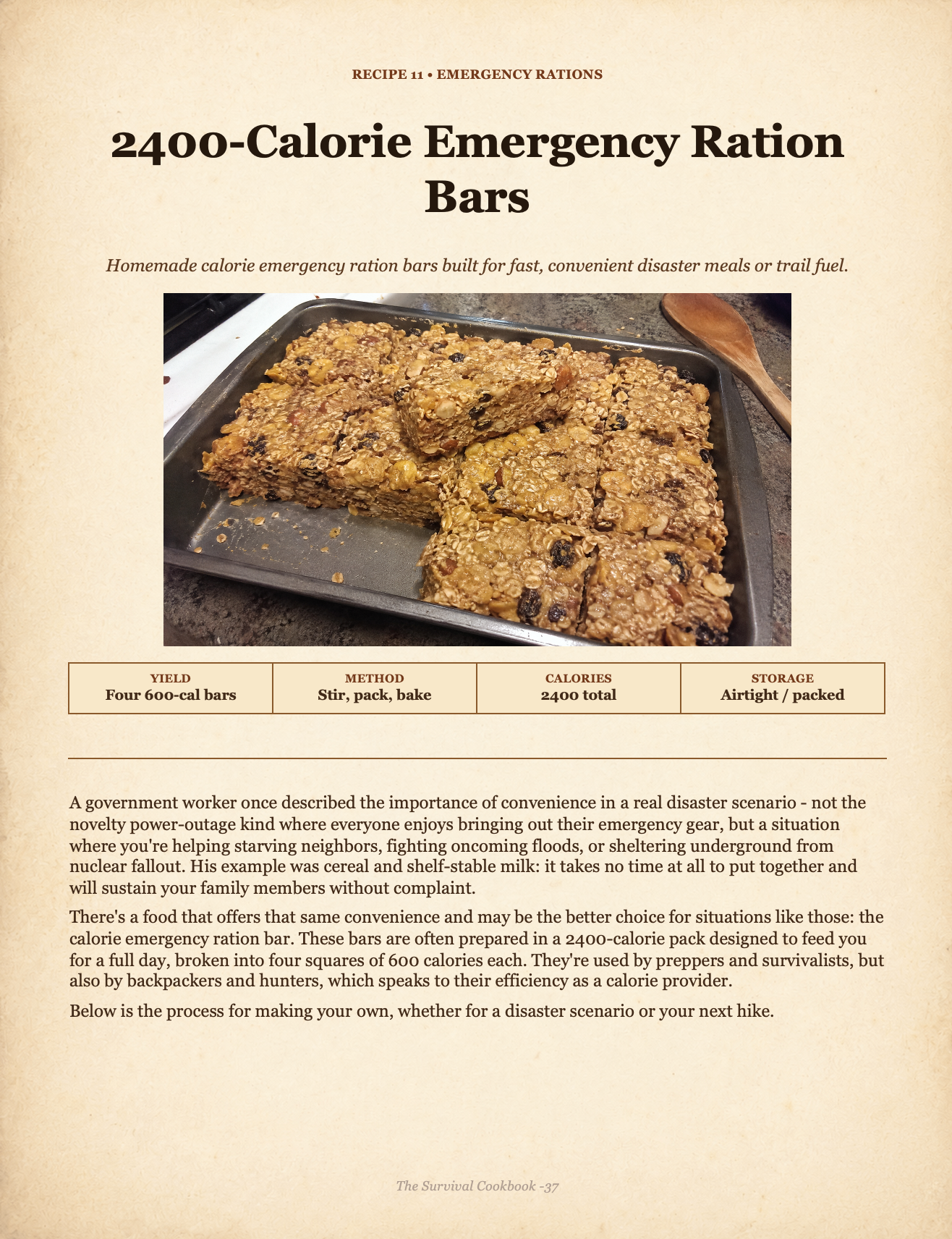
- Ration bars with 2,400 calories each — four bars is a full day of food.
- DIY $20 food bucket, 50 dehydrated foods, egg preservation, and canning safety.
- Every recipe includes yield, shelf life, storage, equipment, directions, and safety notes.
Read on any device or print the pages for your pantry binder. 30-day money-back guarantee — no questions asked.

You Have Food. You Don't Have A Plan.
Right now, your kitchen has pasta, rice, some cans, a freezer full of leftovers. It feels like enough — until the power goes out for three days, or the grocery bill doubles again, or you open the pantry and realize you're staring at ingredients with no idea how to turn them into meals that don't need a fridge.
Your grandmother knew how to handle this. Her grandmother didn't even think about it — it was just how food worked. Somewhere between then and now, we traded that knowledge for the assumption that the lights would always come back on and the store would always have more. That assumption is the emergency.
Your freezer is a ticking clock
When the power goes out, frozen food becomes a race against time. This book teaches you methods that don't need electricity at all.
Grocery prices won't go back down
Depression-era kitchen logic was built for exactly this — stretching cheap cuts, cheap grains, and cheap beans into real meals that store for months.
A pile of cans is not a pantry
Cans with no recipes, no portions, no rotation plan, and no storage system is just a shelf of anxiety. You need a system.
A Complete Shelf-Stable Kitchen — Built From Real Recipes, Not Theory
Every recipe is a working field manual page: what it makes, how long it stores, where to keep it, what equipment you need, and exactly how to use it later. No filler. No lifestyle essays. No recipes that require a $400 dehydrator or ingredients you can't find at a normal grocery store.

Abram Yoder Learned To Preserve Food Before He Learned To Drive
Abram grew up in an Amish family where putting up food wasn't a hobby — it was how you survived the winter. While other kids were learning to use microwaves, he was learning to pressure-can meat alongside his grandmother, dry herbs with his mother, and cure pork with his grandfather using methods that hadn't changed in four generations.
In Amish communities, food preservation isn't a skill you pick up from YouTube. It's handed down at the kitchen table, corrected in real time, and practiced until it's second nature. Canning jars, root cellars, smoke sheds, and pantry rotation aren't quaint traditions — they're how families of eight feed themselves through months of winter with no grocery store run, no freezer, and no backup plan.
Abram eventually left the Amish community, but he never left the kitchen. What he realized was that the skills his family treated as ordinary had almost completely disappeared from mainstream American life.
Every Recipe Is A Printable Field Manual Page
The Survival Cookbook is designed to be printed, punched, and put in a binder next to your canning jars. Every page includes the recipe, yield, shelf life, storage instructions, equipment list, step-by-step directions, field tips, and safety notes — everything you need on one page, with nothing you don't.
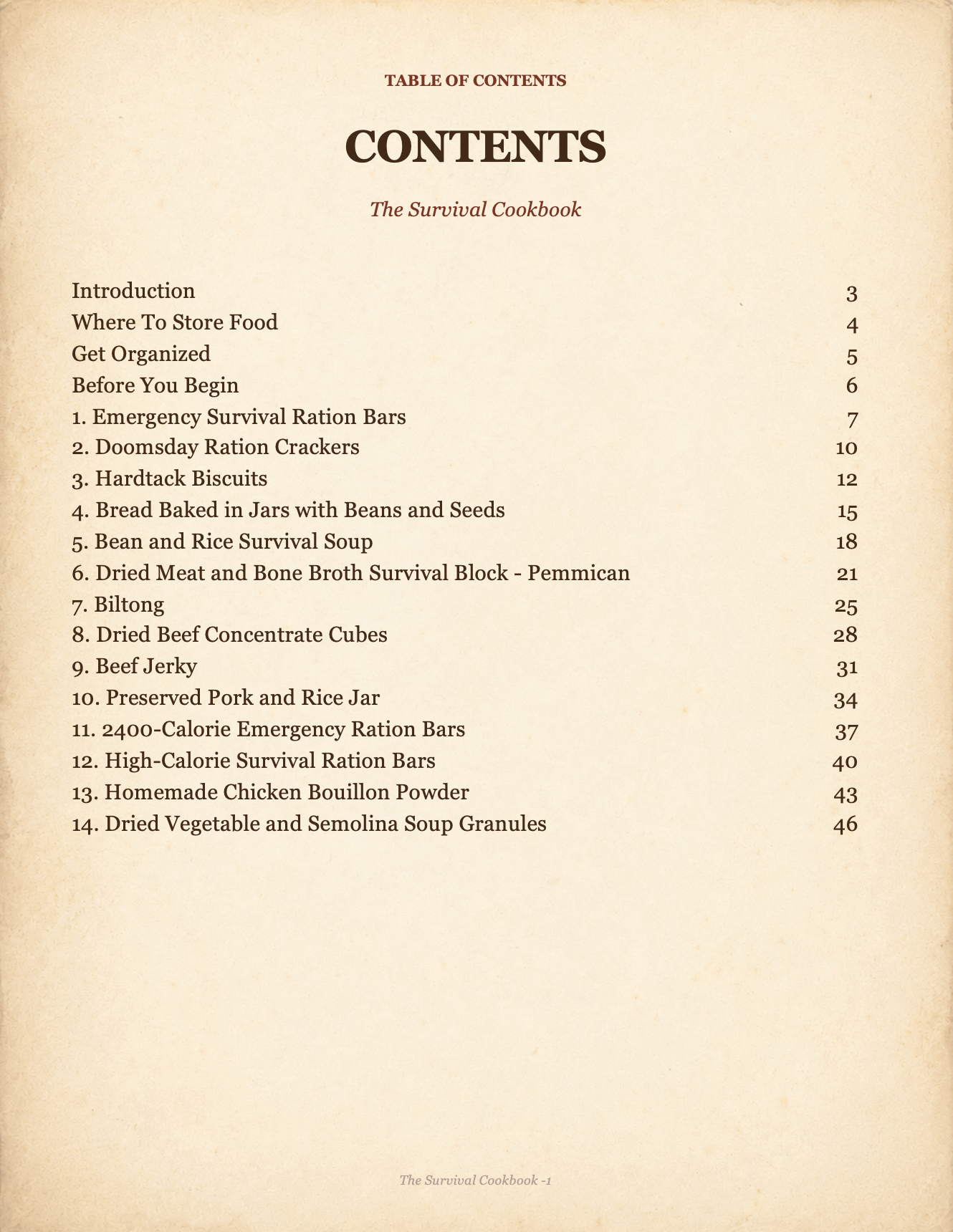
27 Recipes. 9 Reference Chapters. Shelf Lives From 3 Months To 25 Years.
The Appendix Alone Is Worth The Price Of The Book
The Survival Cookbook doesn't stop at 27 recipes. The back half of the book is a complete practical knowledge library — nine reference chapters covering DIY MREs, long-term storage secrets, canning safety, dehydrating, egg preservation, and a step-by-step guide to building a $20 food bucket that stores for 25 years. This is the knowledge that turns a cookbook into a survival system.
Making Your Own MREs at Home
How to build compact, shelf-stable meals from your own pantry that pack lighter than canned food and don't spoil when opened. No military surplus needed.
FIELD CRAFTSmall Tricks That Make Food Last Longer
The storage hacks that add months or years to ordinary pantry food — most of them cost nothing and take less than five minutes.
QUICK WINS19 Foods That Outlast a Crisis
Hardtack, powdered milk, honey, white rice, dry beans, pemmican — the complete list of foods that last years to decades with almost no special equipment. Each one includes storage notes and nutritional data.
LONG-TERM STORAGESeven Deadly Canning Mistakes Even Smart People Make
The critical errors that turn preserved food from lifesaving to life-threatening — including a full explanation of botulism risk and exactly how to prevent it.
SAFETYPressure-Canning Hamburger Meat
Step-by-step instructions for canning ground beef with a 3-to-5-year shelf life. Open the jar and eat it straight, or use it in tacos, pasta sauce, or chili. Includes elevation adjustments and safety warnings.
PROTEINPreserving Eggs in Isinglass
An old-world method for keeping fresh eggs shelf-stable for up to a year without refrigeration. Almost nobody teaches this anymore. Full ingredient list, directions, and taste notes included.
LOST SKILLS50 Foods to Dehydrate for Your Stockpile
Fruits, vegetables, herbs, roots, proteins, and meal makers — the complete dehydrating reference. Grow it, dry it, store it. True food independence starts here.
REFERENCEA DIY $20 Survival Food Bucket
A month's worth of food for one person, shelf-stable for 25 to 30 years, built from grocery store rice and beans for under $20. Pre-made kits sell for $200. This chapter shows you how to build one for a tenth of the price.
BUDGETPreservation Methods — The Complete Reference
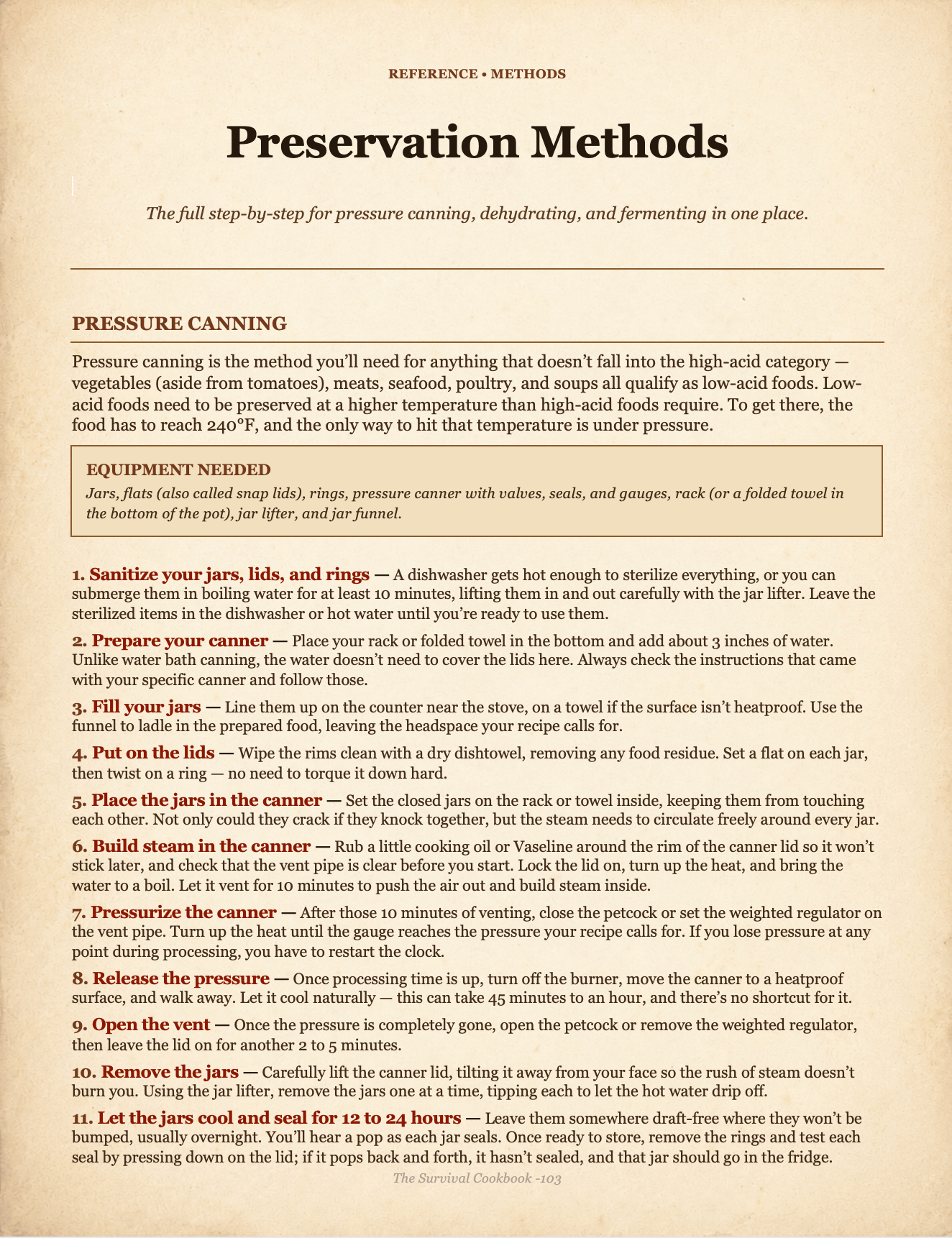
Pressure canning, water bath canning, dehydrating, and fermenting — every method used in the book, explained step-by-step in one place. Includes off-grid canning instructions for when there's no electricity.
STEP-BY-STEPBean and Rice Survival Soup — 270 Servings For Under $300

This is one of the most practical recipes in this book. It requires only water and a heat source to prepare, costs very little to put together, and packs significant protein and complex carbohydrates into every serving.
The large-batch version produces around 270 servings for under $300 — roughly a 90-day food supply for one person. The small-batch version fills two quart jars and costs around $10 to $15.
Ingredients
- Large batch: 4 x 20-pound bags white rice
- 22 x 1-pound bags red kidney beans
- 22 x 1-pound bags barley
- 22 x 1-pound bags lentils
- 6 x 1-pound bags green split peas
- 6 x 1-pound bags chickpeas
- 30 pounds dry bouillon
- Dried seasonings of your choice
- Small batch: ⅔ cup kidney beans; 2 cups barley; 1 cup lentils; ¼ cup green split peas; ¼ cup chickpeas; 1½ cups white rice stored separately; 2 bouillon cubes per jar
Supplies Needed
- Quart mason jars
- Small zip-lock bags for rice
- Small zip-lock bags for seasonings and bouillon
- Large container for mixing dry goods
- Pot for cooking soup
- At least 3 quarts water per jar
- Heat source
- Suggested seasoning per jar: salt, onion flakes, celery flakes, tarragon, black pepper, garlic powder
Directions
- Mix the dry base — Mix all the beans, lentils, barley, split peas, and chickpeas together in a large container. Fill each mason jar just under halfway with this bean mixture.
- Bag the rice — Place 1 to 1½ cups of rice into a small zip-lock bag and seal it. Place the rice bag into the jar on top of the beans.
- Bag the seasonings — Combine your chosen seasonings and bouillon into a second small zip-lock bag and place it in the jar on top of the rice bag. Seal the jar tightly.
- Understand the separation — Beans need significantly longer to cook than rice. Keeping them separate lets you add the rice partway through cooking.
- Prepare to cook — To make one pot of soup from a single quart jar, you need at least 3 quarts of water and a heat source.
- Cook the beans — Pour water into a pot and bring it to heat. Add the bean mixture and seasoning packet. Bring to a simmer, cover, and cook on low heat for 1 to 1½ hours until the beans are fully soft.
- Add the rice — Once the beans are done, stir the rice into the pot. Simmer another 20 minutes or until the rice is cooked through.
- Use optional additions — Add a ham hock, smoked meat, carrots, celery, or potato when available. Vary the spice blend between jars to prevent monotony.
Storage Note
Dried beans last 10 years or more. White rice, kept sealed, holds at 4 to 5 years without vacuum sealing and up to 10 years with it. Keep the spices in a separate small bag inside the jar so the spice packet can be replaced without replacing the beans and rice underneath.
Try The Bean Soup. Then Decide.
Download the book, make the bean and rice survival soup, and see for yourself. If it's not the most practical food prep resource you've ever read, use the guarantee.
This is 1 of 27 recipes in The Survival Cookbook. The full book also includes 9 reference chapters: DIY MREs, 19 foods that never expire, 7 deadly canning mistakes, pressure-canning meat, egg preservation, 50 foods to dehydrate, a $20 survival food bucket guide, and a complete step-by-step preservation methods manual.
The Knowledge To Feed Your Family From Grocery Store Ingredients — For Life
The Pantry Guarantee
Download the book tonight. Open it. Read the first five recipes. Try the bean soup — it costs $10–$15 and feeds a small army.
If the book isn't what you expected — if the recipes aren't practical, if the instructions aren't clear, if it feels like something you've already seen somewhere else — email within 30 days and you'll get a full refund. No questions. No hassle. No hard feelings.
The recipes aren't going anywhere. But the launch price is.
Get Instant Access · $33 →What People Say After They Open The Book
Composite reader scenarios based on common buyer objections and use cases.
"I had a closet full of canned goods and thought I was set. Then I actually did the math — no rotation plan, no idea what meals I could make from any of it, half of it expired. The storage chapter alone reorganized my entire pantry in one afternoon. Now I actually know what I have and when to use it."
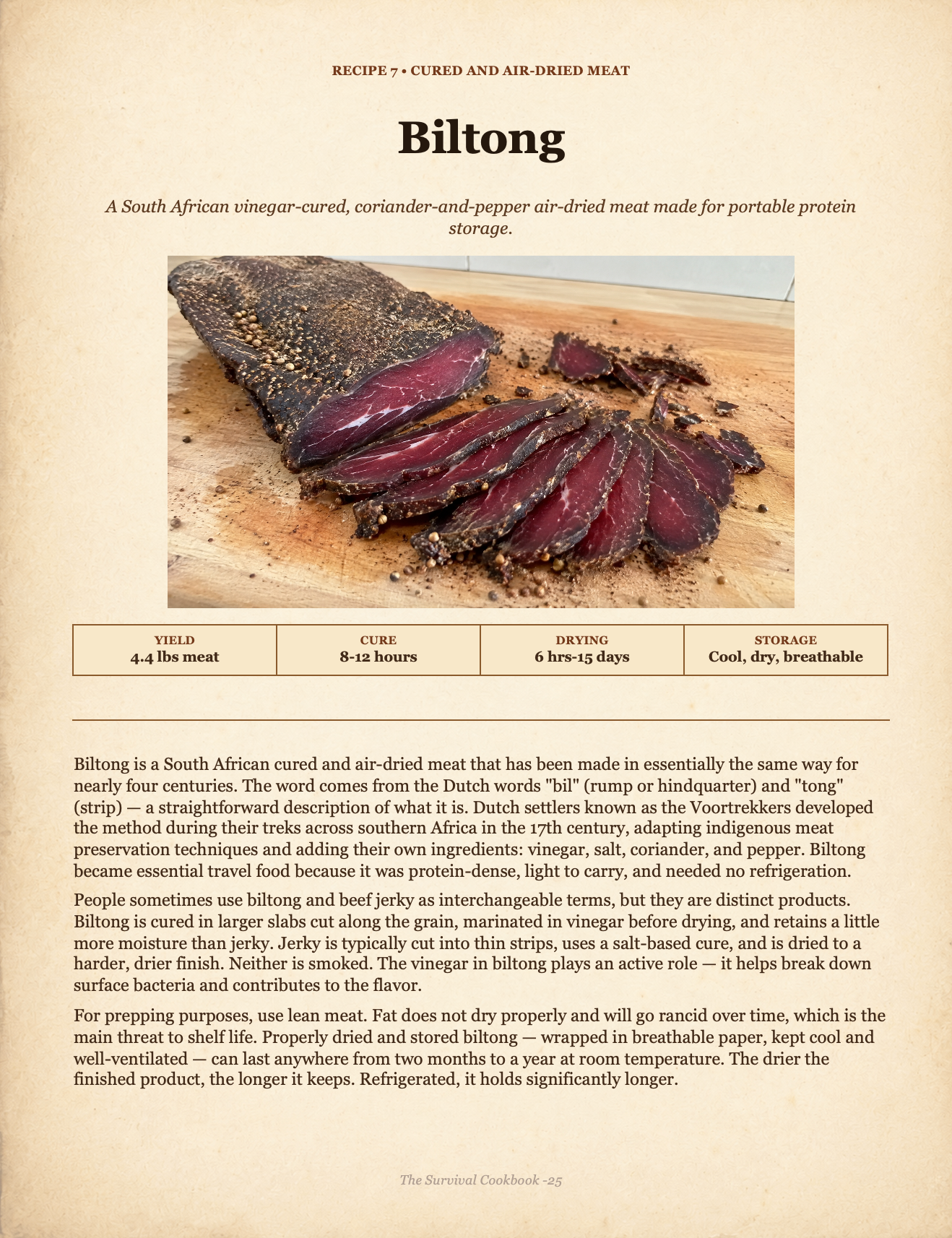
"I didn't buy this for the apocalypse. I bought it because ground beef hit $7 a pound and I got tired of throwing away freezer-burned food every three months. The jerky and the goulash blocks are now regular rotation in our house. My grocery bill dropped and nothing goes to waste anymore."
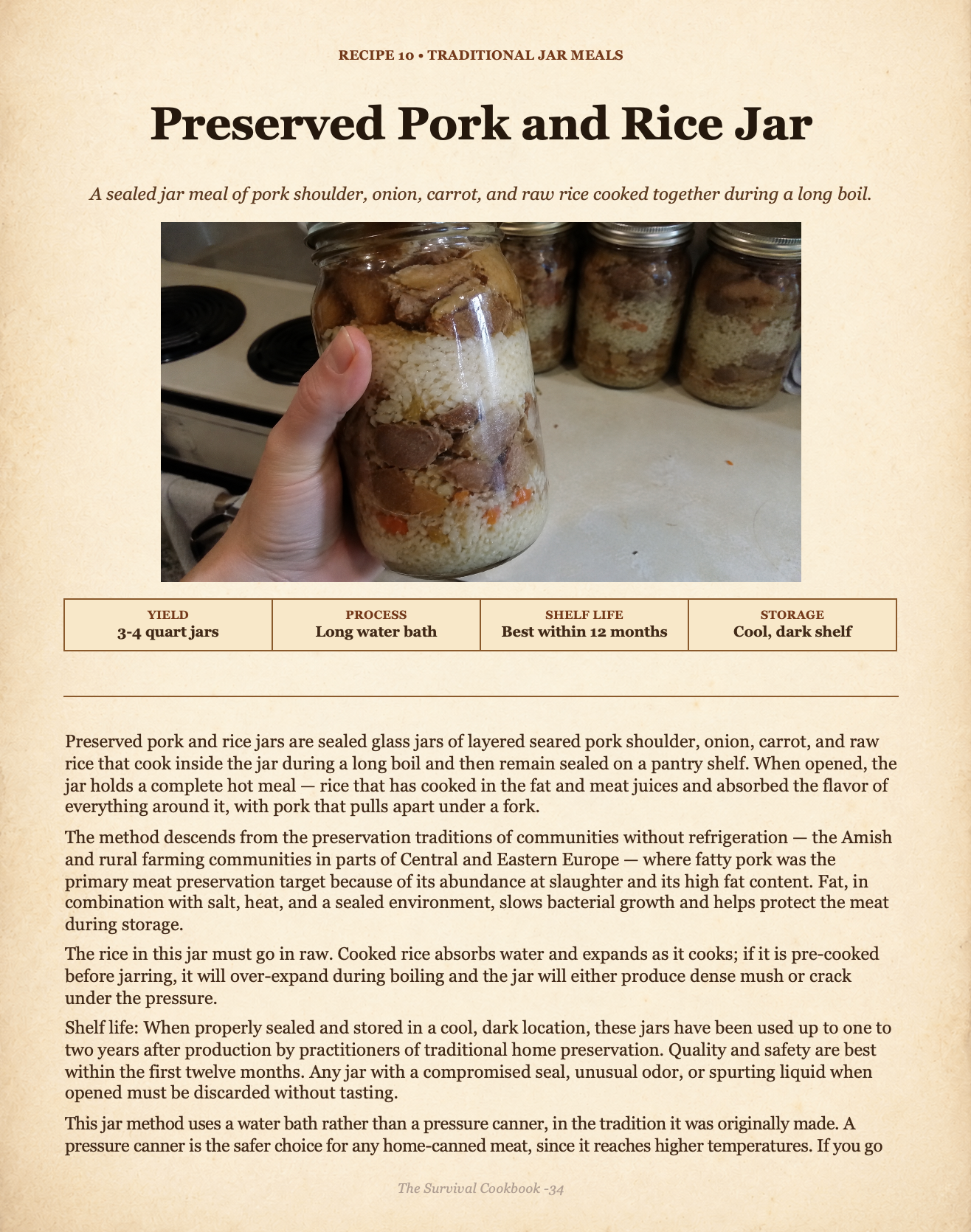
"I expected military ration bars and Depression-era sadness. The pork and rice jar is genuinely one of the best things I've made this year. My kids ate it without knowing it came out of a sealed jar from the pantry shelf. That's the test that matters."
"My first attempt at canning was five years ago and I quit after two hours because every guide I found assumed I already knew what I was doing. This book walks you through like someone is standing next to you. I pressure-canned potatoes on my first try. Twelve jars, all sealed."
"I printed the whole thing and put it in a three-ring binder. It sits on the shelf next to my canning jars. Every recipe has the yield, the shelf life, and the storage notes right on the page. I've spent more than $33 on cookbooks that give you half this much information and none of the preservation detail."
"I watched probably forty hours of canning and preservation videos over two years and still didn't trust myself to actually do it. Too many conflicting methods, too many people skipping the safety steps. This book gives you one clear method per recipe, tells you exactly what's safe and what isn't, and doesn't waste your time. I made the bean soup the night I downloaded it."
Composite reader scenarios. Replace with verified customer testimonials when available.
FAQ
Somewhere in the last few generations, we traded a skill for a convenience. We stopped putting up food because the store would always have more and the lights would always come back on.
Most of the time, that bet pays off. But “most of the time” isn't the same as “always” — and the families who do fine when something goes wrong aren't the lucky ones. They're the ones who never stopped knowing how to feed themselves.
You don't need to master every recipe tonight. Can one thing this season. Dehydrate one thing next. Let your pantry grow a jar at a time — until one day you look at the shelf and realize you've built something worth more than it looks.
That Shelf Isn't Just Food. It's The Version Of Your Family That Doesn't Have To Wonder What Happens Next.
Start Building Your Pantry · $33 →Get The Pantry Starter Note
Leave your email and get the launch reminder plus one practical pantry note from Abram. No spam. No fake scarcity.